
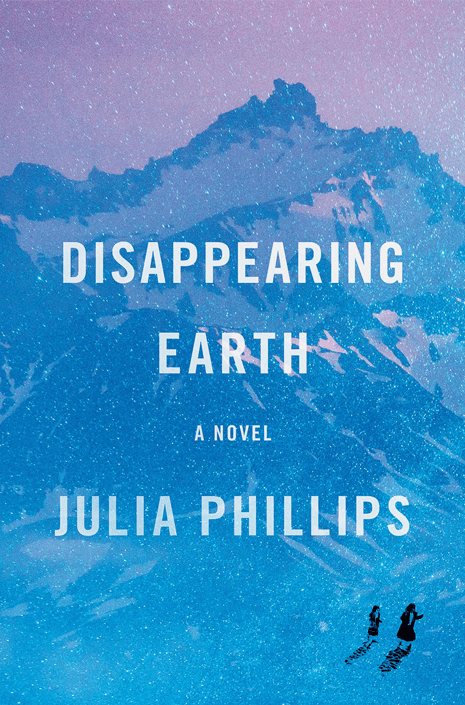
Julia Phillips debut novel is ambitious, toys with and reverses common tropes, and while not always fulling the broad ambition of her exotic locale and subject’s promise, nonetheless creates a vivid world and piercing study of love and loss, and in equal parts their pain and beauty.
Disappearing Earth is set in the remote volcanic hinterland of the Russian Kamchatka peninsula. Much like popular thriller writers who have tantalized us through the cold remoteness of the Scandinavian peninsula, the novel begins abruptly with the abduction of two small girls. This however, before the novel is begun in earnest, is where any comparisons to Steig Larson or Jo Nesbo and his Harry Hole end. For what Phillips presents in what is ostensibly a beautifully printed yet standard ‘missing girl’ tale, borrows further into the psyche and is willing to meditate on the themes I’ve mentioned above in a way that no book, comparable at a glance perhaps, has.
From this initial episode of abduction, we are thrust forward another month, from August to September, and introduced to an entirely unrelated family living in Petropavlovsk, the largest city on this foreign peninsula. I say ‘foreign’ not as a reminder that the novel is set in Russia, but to underline that no piece of pop culture or media have ever even mentioned this place, to my knowledge at least. I had absolutely no notion of Kamchatka before browsing through images on Google. I still don’t, which may reflect somewhat on the novel. My best guess is that the experience exists somewhere between Iceland’s similarly volcanic harshness and the vast but life-giving remoteness of the southern island of New Zealand, all mixed with the quintessential brutality and cheapness of Soviet architecture and design. In any case, month by month we advance through the lives of Kamchatka’s residents, into the winter and through the spring. The novel’s true raison d’etre lies in this episodic exploration of the individual. Particularly the exploration of women, who scratch a living or manage to survive on this hash edge of the world. Phillips’ collection of characters fall at times into the formulaic, subordinating wives, overbearing mothers, sleazy boyfriends. It’s one of my only disappointments with the novel, that our familiarity with some of Phillip’s characters passes beyond identifiability and begins to melt into archetypical trope. Unfortunately, this feeling is neither subsided by the necessity of these characters to drive forward any meaningful point of plot. Again, while ‘bait and switch’ feels a bit harsh, this book is not about these two girls. No, where the novel truly hinges and where it lives – where fair critiques might be drawn and where its power lies – is through the use of these characters, as vassals in Phillip’s exploration of love. What a poverty of language that we use such a simple word to describe so much – which is really the point.
As each chapter advances month by month pass with no news or word of our abductees’ fate. I wouldn’t say this built tension, as much as exacerbated my need for something, anything, to happen. Instead, we continue to weave through the lives of Kamchatka’s residents, whose lives themselves occasionally intertwine. This approach to narrative and character arc as secondary to the emotional exploration of those characters is really the frustrating but brilliant diamond at the core of Phillips’ effort. My whining of easily spotted archetypes and lack of motion is immaterial. Complaints regarding a lack of drama or suspense have missed the mark. While I had hardly put the book down before I sat to type this, I cannot remember the names of half it’s characters. I don’t think this is uncommon though, as just behind the book’s dedication a handy cheat sheet appears, listing everyone’s familial relation, surname, and connection. In sort of a devious way, I can’t help but grin as the novel flips it’s ‘missing girls’ from trope to mere literary tease. On places like Amazon or Google, you’ll see this book indexed as ‘suspense’ or ‘thriller’. Let me affirm that this novel is hardly either. The narrative thread following these two children only really bookends our story. Truly, the novel is hardly about the girls at all. Instead, these children act as a vehicle, introducing us into the lives of women, whose concern for their abduction ranges from apathy to horror, across the peninsula who directly and indirectly deal with this event and their own troubled lives.
There are moments in this novel that simply radiate. I cannot push from my mind an episode which introduces us to a local denizen of Petropavlovsk, whose husband has left her for another woman, and who now resides alone with her canine companion. The love between man and pet is a love without equivalence, and one which Phillips explores with equal depth and validity as another romance or story of lustful yearning in the novel. In this episode Oksana entrusts a fellow scientist and coworker to let her dog out in the afternoon. When Oksana returns in the evening, her sole companion has gone missing, a door left unlocked by her hapless coworker. Oksana searches the streets, increasingly desperate as the sun begins to fade behind Kamchatka’s looming mountains. Eventually, she returns to her apartment in the darkness, alone. Disappearing Earth is at it’s finest in these explorations of broken lives and what happens when the center fails to hold. Phillips exploration love and loss resonates far more powerfully than the actual events or goings-on of her subjects. Ultimately, the fates and trials of these women are hardly resolved, we never again hear from Oksana or her beloved friend. In the end though, we are brought to resolution for the novel’s initial teasing question. Yet in her presentation, again, Phillips manages to avoid the cliche, and while reassuring the fate we, I should hope, all hoped for these girls, sticks us with a final tinge of grief and horror. Phillips delivers a novel which leaves us wanting more of her. In this, her first novel, she reaches for and at times manages to firmly raise herself to extraordinary level. As an initial outing, she has tossed aside any inclination to simply dip her toes. For whatever Disappearing Earth is in want of, I would certainly prefer it to remain in that want than boil itself down into some banal facsimile of an airport-stall thriller. Julia Phillips is an extraordinary talent and I can’t wait to see what she does next.
 The Logorrhean