
When Sir Edmund Hillary and Tenzing Norgay became the first men to step upon the summit of Mount Everest in 1953, a watershed moment was at hand. Sir Edmund’s ascent of the mountain was man’s final and total flexing of dominion over the natural world. Today, only the deepest crevices of the Atlantic ocean remain beyond our reach. Today, sixty-seven years later, hundreds of men and women make the climb every season. Tourist climbers have become a dependable source of income for the local economy and litter the mountain with thousands of pounds of trash every year. The mystic wonder of the mountain is gone. It’s symbolism and humbling power along with it. This type of story is hardly limited to the natural world, there are few places that have managed to retain their share of wonder and avoid this sort of defilement. Today, most ships coming into Havana ferry tourists looking to snap pictures of a city they know from Hollywood. Leaving the Santa Maria Novella train station in Florence, one is immediately greeted by the golden arches of McDonald’s across the street. Stories of culture death aren’t limited to exotic locales. Look no further than the occasional sign pointing out ‘Historic Route 66’. It also the story of Hav, or at least I think it is.
In the epilogue of Hav, Jan Morris writes, “After forty odd years of wandering the world and writing about it, I had come to realize that I really seldom knew what I was writing about.” With Hav as well, we’re not quite sure what Morris is writing about and she readily admits as much a few sentences later, “I can only leave it to my readers, apologetically, to decide for themselves what it’s all about.” For another writer of another novel, this refusal to publicly commit their work to a stated aim or purpose might rightly be derided. It’s not cheap or a failure of understanding to ask of Hav, ‘What’s the point?’. But this willful ambiguity, Morris’s refusal to engage in the explicit, is exactly what makes Hav such a brilliant novel.
Morris documents her six-month stay in this imagined city through diary entries. Recounted as a travel log, she dutifully records her impressions of the city and it’s idiosyncrasies along with the notes of her conversations and encounters as she wanders the streets, alleyways, and coastline. We’re told of it’s political history, of its time under the thumb of Imperial Russia, the Ottomans, it’s brief years as a British colony, and finally, it’s post-world war status as an independent province. This political history, along with the city’s ambiguous location somewhere near Anatolia, sets the backdrop for a vast array of cultural influence and intersection. We walk with Morris through the city’s French, German, Russian, and Arabic quarters. We walk along the crowded alleys of Yuan Wen Kuo, the peninsula’s habitat for Chinese merchants and fishermen, and the small island of San Spiridon, where a Greek people, most ancient we’re told, still live to this day.
From this vivid geography and history come characters, who serve no purpose but to further color our imaginations of this place. Hav has no protagonist, no villain, no real story to speak of. The plot, as much as there is one, meanders along without any more aim or urgency than the harbor-front strolls or afternoon cups of tea Morris shares at the city’s Athenaeum, a club for the local academic and cultural elite. Through her months in the city we’re introduced to a dozen or so denizens of the peninsula on which port city resides. By the end of her journey, Morris has been introduced to or by chance encountered a vast range of personalities bringing life to the city’s layered and complex history. She dines with Turkish magistrates, shares lunch with local dock workers, sits for tea with the reclusive and mysterious British Agent, and, being introduced through layers of security and precaution, to a man claiming to be the rightful Caliph living in hiding for fear of assassination from the Turkish government. Morris even meets for lunch with a former SS officer, hiding in the streets of Hav from the Israeli Mossad, who Morris is told would pay handsomely for information on his whereabouts. Through these sometimes mundane and sometimes fantastical interactions, one by one strokes of color and depth are pressed upon the canvas of Hav. Each one somehow further pulling this city of imagination into reality, while pushing our understanding of its life and history further into the shadows. This is no accident. Early editions of the novel featured an endless maze upon the cover, the official emblem of the city.
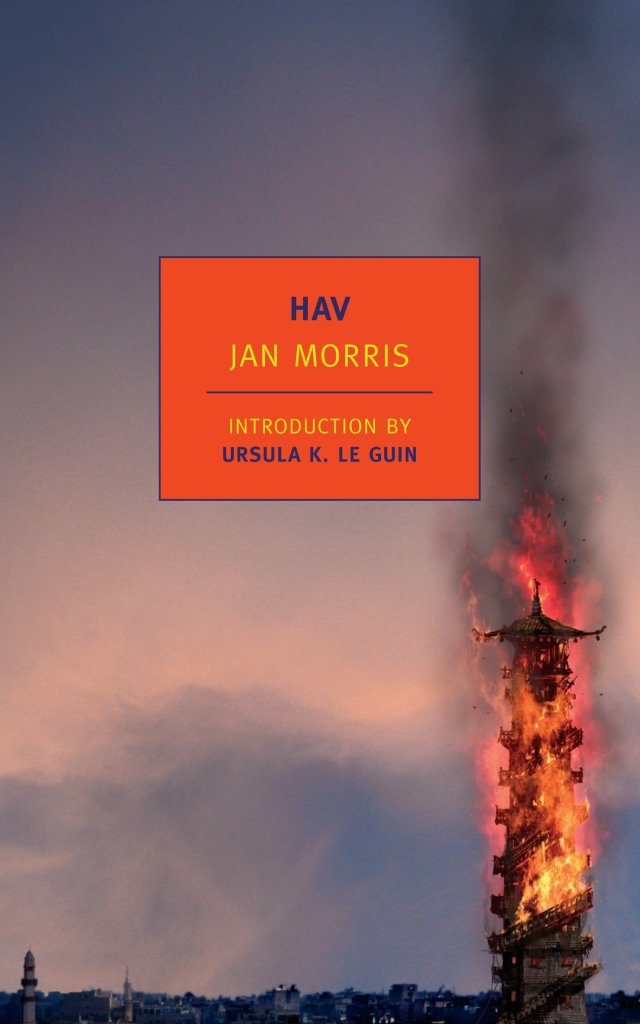
In 2005, Morris revisited Hav and published Hav of the Myrmidons. The city she sees bears little resemblance to the pulsating Mediterranean hub she first visited twenty years prior. The people have changed and the landscape along with them. The old port has been destroyed, replaced by a cruise line terminal. From here passengers disembark onto a resort called Lazaretto! (the punctuation is part of the spelling) about which patrons remark how safe they feel. The House of the Chinese Master, which is featured in flames on the novel’s cover, has been replaced by a skyscraper, replete with helipads and massive ‘M’ upon its crown. The difference between Old Hav and New Hav is the difference between the Mount Everest of Sir Edmund and the one you or might see, were we inclined to make the trek from Katmandu. Might we have even had the chance to visit the mountain in those days? Probably not. But its hard not to feel like the trade-off has not been worth it. Freedom of travel and the speed of modern transit have unlocked exotic destinations around the world for millions. But these places are delicate, fragile, as Old Hav was fragile. While under the layers of concrete and postmodernism New Hav still bears the character and complexity of its past, reality isn’t always as generous.
With her novel, Morris creates a portrait of a place incredibly familiar, yet opaque, just beyond our touch and understanding. I imagine past surveyors and architects of London, knowing every street and mound and undulating road of their city, only to discover for the first time the presence of a Roman temple or bathhouse underneath their feet. What might it feel like to so suddenly be forced to reconcile the world as we know it with the world as it is? Hav of course is imaginary, but’s mazes of meaning, histories of peoples past and living, and it’s clashes of civilizations falling upon one another century after century are as real as any place in our world. We never get the full story, rumors remain rumors, the people of Hav remain as tight-lipped, untrustworthy, or simply disinterested by Morris’s questions at the end of the novel as they were in the beginning. Through Hav, both Old and New, we reconcile that we rarely ever truly know a place. Moreover, that a place exists outside the time and place of even own its residents. It’s the sole possessor of its secrets. The existence of these vaults, hidden by time and earth, breathe life into our cities. While the modernizing and homogenizing western world has dulled the glimmer of cities from which Hav was inspired, that sparkle remains, if your willing to look for it.
 The Logorrhean